
5 High Protein Smoothie Combos That Keep You Full Till Lunch
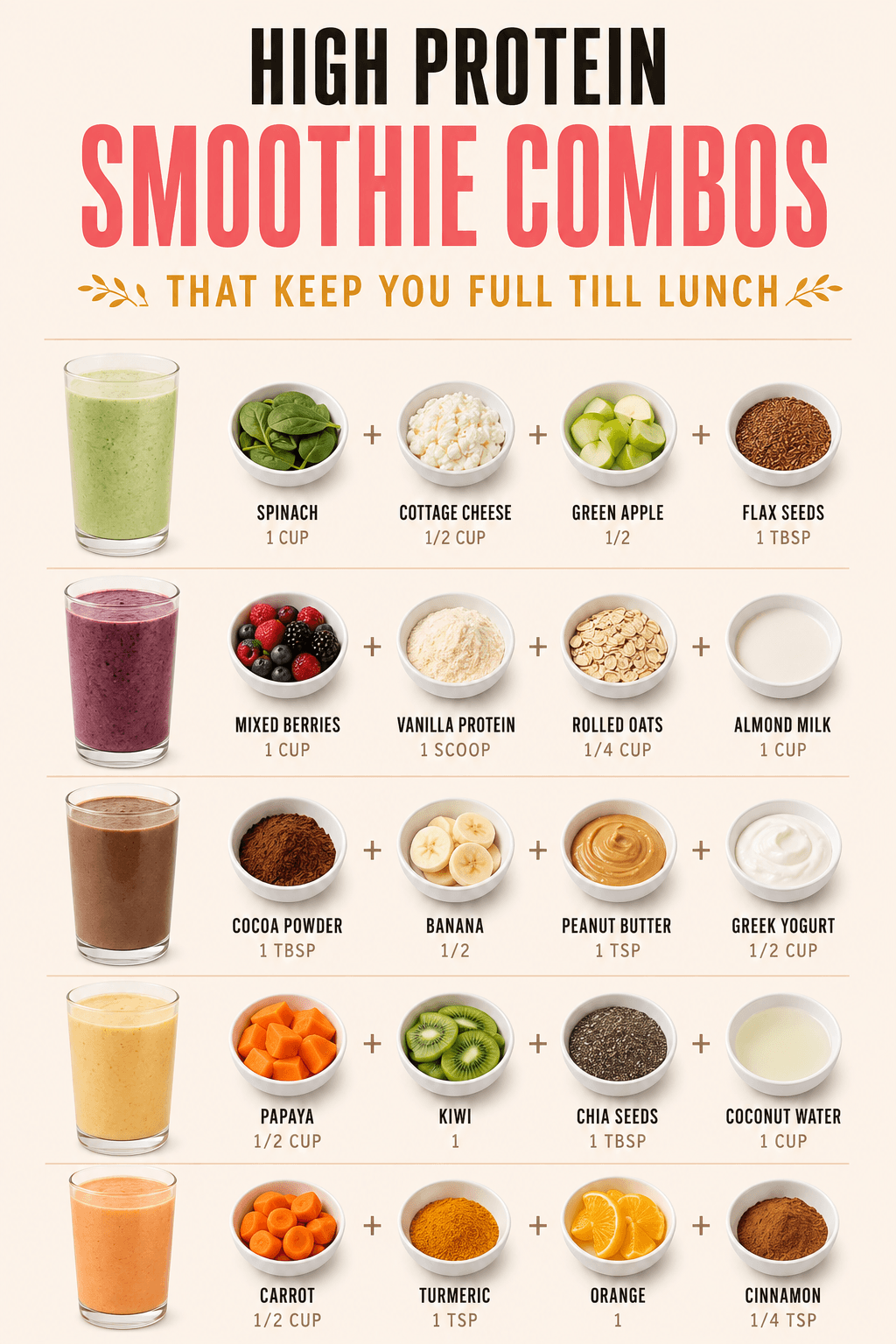
Most smoothies fail the same way: they taste great, they take five minutes, and you're hungry again by 10am. That's not a willpower problem — it's a recipe problem. A blend of fruit and juice is basically fast-digesting sugar with nothing to slow it down, so blood sugar spikes, drops, and takes your morning with it.
The fix is a formula, not a superfood. Every smoothie below pairs a protein anchor (cottage cheese, Greek yogurt, protein powder) with fiber and a little fat (oats, flax, chia, nut butter). Protein and fat slow digestion, fiber adds volume, and the combination is what actually carries you to lunch.
Below are five combos with exact measurements, roughly what each one delivers, and how to adjust them. Save the infographic, screenshot the one you want to try, and blend it tomorrow morning.
Why Most Smoothies Leave You Hungry by 10am
A typical smoothie — banana, berries, juice, maybe a splash of honey — can easily hit 300 calories while delivering under 5 grams of protein. Liquid calories also bypass a lot of the chewing and stomach-stretching signals that tell your brain you've eaten a meal, so it registers more like a drink than breakfast.
Research on satiety consistently points to the same three levers: protein, fiber, and food volume. Protein is the most filling macronutrient per calorie, fiber slows how quickly sugar hits your bloodstream, and volume physically fills your stomach. A smoothie built on fruit alone gives you volume and a little fiber, but almost no protein — so it fills you for about 90 minutes.
Practical rule: aim for at least 20 grams of protein and 5 or more grams of fiber in any smoothie you're calling breakfast. Every combo below is built to that target, or gets there with one small addition.
1. Green Spinach & Cottage Cheese Smoothie
Ingredients: 1 cup spinach, 1/2 cup cottage cheese, 1/2 green apple, 1 tbsp flax seeds. Blend with 1/2 to 1 cup of cold water or milk until completely smooth.
Cottage cheese is the quiet star here — half a cup delivers roughly 12-14g of protein, most of it slow-digesting casein, which is exactly what you want when the goal is staying full for hours rather than minutes. Blended, it disappears completely into a creamy texture with none of the curd texture people avoid.
Green apple keeps it tart and low in sugar, spinach adds volume and micronutrients without flavor, and ground flax adds about 3g of fiber plus omega-3 fats. Roughly 15g protein and 6g fiber for around 250 calories.
Practical tip: use ground flax, not whole seeds — whole flax passes through mostly undigested, so you get the crunch and none of the benefit. If you want it above 20g protein, add a scoop of unflavored or vanilla protein powder.
2. Mixed Berry Protein & Oats Smoothie
Ingredients: 1 cup mixed berries, 1 scoop vanilla protein powder, 1/4 cup rolled oats, 1 cup almond milk. Blend until the oats are fully broken down, about 45 seconds.
This is the highest-protein combo on the list and the closest thing to a full breakfast in a glass — usually 25-30g of protein depending on your powder, plus about 8g of fiber between the berries and oats. It's the one to pick on training days or whenever you know lunch is going to be late.
Rolled oats blend into a mild, slightly thick base and bring beta-glucan, a soluble fiber specifically linked to slower digestion and steadier blood sugar. Berries are the lowest-sugar fruit option and bring the most antioxidants per calorie.
Practical tip: soak the oats in the almond milk for 10 minutes (or overnight in the fridge) before blending. They break down more completely, and the whole thing comes out silky instead of gritty.
3. Chocolate Peanut Butter Greek Yogurt Smoothie
Ingredients: 1 tbsp cocoa powder, 1/2 banana, 1 tsp peanut butter, 1/2 cup Greek yogurt. Blend with 1/2 cup milk of choice and a handful of ice.
This is the combo that stops the 3pm chocolate craving, because it satisfies it at 8am instead. Half a cup of plain Greek yogurt carries 10-12g of protein and gives it a thick, milkshake-like body, while unsweetened cocoa powder brings deep chocolate flavor for about 12 calories and zero sugar.
Half a banana is enough for natural sweetness without turning it into a sugar bomb, and a teaspoon of peanut butter adds just enough fat to round out the flavor and slow everything down further. About 15g protein for roughly 220 calories.
Practical tip: use frozen banana slices instead of ice. You get the same cold, thick texture without watering down the flavor — freeze a batch of halved bananas on a tray so they're always ready.
4. Tropical Papaya, Kiwi & Chia Smoothie
Ingredients: 1/2 cup papaya, 1 kiwi, 1 tbsp chia seeds, 1 cup coconut water. Blend the fruit and coconut water first, then stir in the chia and let it sit 5 minutes.
This is the lightest combo on the list and the best one for digestion — papaya contains papain and kiwi contains actinidin, both enzymes that help break down protein, which is why this pairing sits well on a sensitive stomach. Coconut water adds potassium and electrolytes without the thickness of milk.
Chia is doing the satiety work: 1 tablespoon brings about 5g of fiber and absorbs up to 10 times its weight in liquid, forming a gel that physically slows digestion. Letting it sit for a few minutes before drinking is what turns this from a juice into something filling.
Practical tip: on its own this combo is fiber-rich but low in protein — around 4g. To make it a real breakfast rather than a snack, blend in 1/2 cup of Greek yogurt or a scoop of unflavored protein powder. It stays light and the tropical flavor doesn't change.
5. Carrot, Turmeric & Orange Smoothie
Ingredients: 1/2 cup carrot, 1 tsp turmeric, 1 orange, 1/4 tsp cinnamon. Blend with 1/2 cup water or orange juice until completely smooth.
Think of this one as a golden-hour immunity shot scaled up to a glass. Carrots bring beta-carotene, the orange delivers a full day's vitamin C, turmeric contributes curcumin for its anti-inflammatory properties, and cinnamon has modest evidence for supporting blood sugar control.
It's bright, warming, and completely different from the other four — a good rotation option when you're tired of creamy smoothies. Naturally sweet enough that it needs nothing added.
Practical tip: add a pinch of black pepper. Piperine dramatically increases curcumin absorption, and at that quantity you won't taste it. Like the tropical combo, this one is low in protein on its own — pair it with eggs or add Greek yogurt if it's your main breakfast.
The Formula: Build Your Own High Protein Smoothie
Once you see the pattern, you don't need recipes at all. Every filling smoothie is the same four slots: 1 protein anchor + 1 fiber source + 1 to 2 cups of fruit or vegetables + 1 cup of liquid.
Protein anchors (pick one): 1/2 cup Greek yogurt, 1/2 cup cottage cheese, 1 scoop protein powder, 1/2 block silken tofu, or 2 tbsp hemp seeds. Fiber sources (pick one): 1 tbsp chia, 1 tbsp ground flax, 1/4 cup rolled oats, or 1 tbsp nut butter for fat and staying power.
Produce (1-2 cups): frozen is better than fresh here — it's cheaper, it's picked at ripeness, and it gives you thickness without ice. Liquid (1 cup): water, milk, almond milk, or coconut water. Skip fruit juice; it adds sugar without the fiber that makes fruit filling in the first place.
Practical tip: build freezer packs. Portion the produce and fiber for five smoothies into bags on Sunday, then each morning dump one into the blender with your protein and liquid. It turns a 10-minute task into a 2-minute one, which is usually the difference between doing it and skipping it.
4 Mistakes That Turn a Healthy Smoothie Into a Dessert
Too much fruit. Three or four servings of fruit blended together can push 40g+ of sugar. Cap it at 1-2 cups total and let the protein and fiber carry the rest.
Juice as the liquid base. A cup of orange juice adds around 100 calories of pure sugar with none of the fiber from whole oranges. Water, milk, or unsweetened plant milk keeps the sugar where it belongs.
Adding sweeteners on top. Honey, agave, maple syrup, dates — a flavored protein powder plus ripe fruit is almost always sweet enough already. Taste before you add anything.
Drinking it too fast. A smoothie you drain in 60 seconds registers differently than one you sip over 10 minutes. Slowing down gives satiety signals time to arrive, and it's the easiest fix on this list.
Frequently Asked Questions
How much protein should a breakfast smoothie have?
Aim for at least 20-25g of protein if the smoothie is replacing a meal. That's the range most consistently linked to feeling full for three to four hours. The berry protein oats combo hits it on its own; the others get there with a scoop of protein powder or an extra half cup of Greek yogurt.
Can you taste cottage cheese in a smoothie?
No. Once fully blended it dissolves into a creamy, slightly tangy base — closer to Greek yogurt than to cottage cheese. Blend for a full 45-60 seconds to eliminate any texture, and pair it with a tart fruit like green apple or berries.
Are high protein smoothies good for weight loss?
They can be, when they replace a higher-calorie breakfast and keep you from snacking mid-morning. The mechanism is satiety, not the smoothie itself — a protein-and-fiber smoothie at around 250-300 calories that holds you till lunch works; a 500-calorie fruit-and-juice blend that leaves you hungry at 10am does not.
Can I make these smoothies the night before?
Yes, with a caveat. Blended smoothies keep 24 hours in a sealed jar in the fridge, though they'll separate — just shake before drinking. Green smoothies with spinach hold up best; chia-based ones will thicken considerably overnight, so add a splash of liquid in the morning. Freezer packs of pre-portioned ingredients are the better make-ahead option.
Which smoothie is best for a sensitive stomach?
The tropical papaya, kiwi and chia combo. Papain and actinidin, the enzymes in papaya and kiwi, help break down protein, and coconut water is gentler than dairy. If dairy is the issue, swap Greek yogurt for a plant-based protein powder in any of the other recipes.
Do I need a high-powered blender for these?
No. A standard blender handles all five if you add liquid first and blend in stages. For oats and flax, soaking them in the liquid for 10 minutes beforehand does most of the work that a stronger motor would otherwise do.
This article is for general informational purposes only and is not medical advice. Nutritional values are approximate and vary by brand and portion. If you have a food allergy, a digestive condition, kidney disease, or are pregnant or breastfeeding, consult a doctor or registered dietitian before changing your diet — and note that turmeric in larger amounts can interact with blood-thinning medication.
Want an easier way to stick with these habits?
Nuwmi turns this cheat sheet into a daily, judgment-free journal you can carry in your pocket.
Download for iOS